
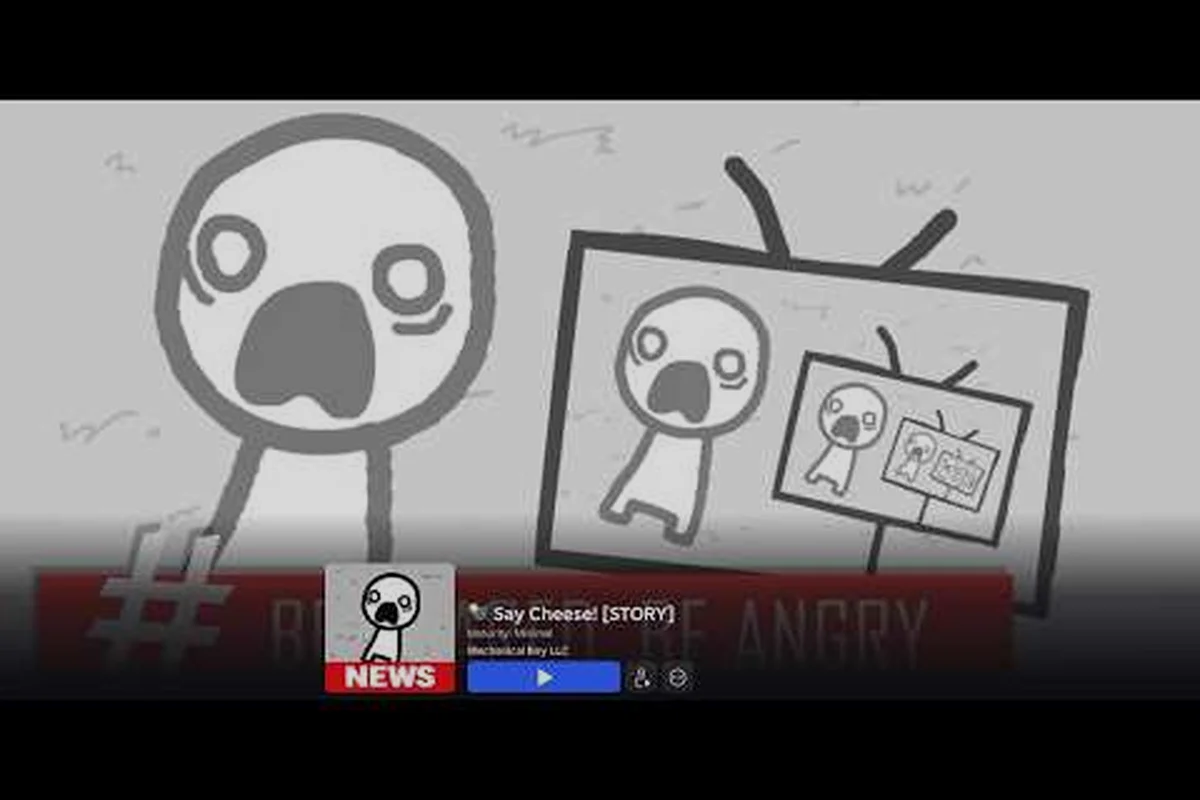
The Say Cheese Roblox news broadcast is a framing device, not a documented interface. It shapes how a journalist’s choices become public attention, and the official page gives players a useful basis for interpreting the game without inventing mechanics.
News and Screens in the Official Text
The official Roblox page describes Say Cheese! as an Adventure / Story experience with a journalism premise: the player works for “Big Media,” visits a park, and is expected to create chaos and panic while a large audience watches. The page also states that the player is on camera. Those details establish news as context and broadcast visibility as a premise, but they do not identify a separate broadcast menu, screen, or control panel.
That distinction matters because a visual theme can be mistaken for a documented system. A camera image, a news-style image, or a scene showing an audience does not prove that the game has a named broadcast interface. The official description gives no technical label for it. The safest interpretation is that the news broadcast frames the player’s actions as events being witnessed, reported, and amplified.
| Textual anchor | Literal meaning | Interpretive limit |
|---|---|---|
| The player is a journalist | The protagonist works in media | It does not document a journalism skill system |
| The setting is a park | The reported location is a public park | It does not define a traversable area list |
| The audience must watch | Public attention is part of the premise | It does not specify a numerical attention meter |
| “You’re on camera” | Visibility is emphasized | It does not identify a named camera operation |
| “The choice is yours” | Player agency is explicit | It does not enumerate the available choices |
Literal Evidence Versus Interpretation
A reliable reading separates three layers: what the official page states, what the player observes, and what that observation may reasonably suggest. The first layer is narrow. Say Cheese! presents a journalist, a park, media attention, public panic, and a choice between destroying a peaceful society or changing fate to bring hope.
The second layer belongs to actual play. Players can watch how information appears, which actions attract a crowd, and how reactions develop. The third layer is interpretation. If attention seems to rise after a disruptive act, a player may reasonably frame that act as socially amplifying, although the official page does not document a numerical attention system or a fixed causal rule.
This evidence hierarchy keeps analysis grounded. It allows the Say Cheese Roblox news broadcast to be studied as a narrative lens without presenting an inferred feature as confirmed content. For broader context, the new-player guide can help organize initial observation before deeper interpretation begins.
Why Framing Changes Player Expectations
Framing affects what counts as a meaningful action. In a conventional scenario, a camera might simply represent recording. In this premise, however, the journalist is hired to spread chaos and panic while billions are imagined to watch. That changes the moral texture of the scene: the player is not merely observing public disorder but appears to be actively producing material for mass consumption.
The official page also gives the story a binary thematic frame. One path destroys a peaceful society, while the other changes fate to bring hope. That does not expose every individual decision available during play, but it establishes the larger consequence axis: public harm versus hopeful transformation. A player can therefore evaluate a choice by asking what kind of broadcast it helps create, what audience reaction it invites, and how it contributes to the final direction of the narrative.
Billions Must Watch: Audience as a Game Element
The official description’s promise that billions will watch is important even though no audience count is documented. The phrase does not mean that millions of independent players are connected to one server. It frames the player’s actions as events with a mass audience, making attention part of the story’s pressure system. The Mechanical Boy LLC's group page on Roblox is the most reliable source for checking these official statements as the experience changes.
As of 2026-10-31, the game page records 3,955,237 visits, 13,403 players, 49,747 favorites, and 12,154 likes against 1,369 dislikes. These are platform-level snapshots rather than permanent values, and they demonstrate interest in the experience. They do not establish how many people react to choices inside a scene. The official maximum server capacity is 12, but that figure describes server capacity only, not the design of the audience system.
| Public signal | Snapshot as of 2026-10-31 | What it supports |
|---|---|---|
| Visits | 3,955,237 | The experience has reached a substantial public audience |
| Players | 13,403 | There was notable activity at the snapshot time |
| Favorites | 49,747 | Many users had marked the experience for later attention |
| Likes and dislikes | 12,154 and 1,369 | The public reaction was approximately 90% positive |
| Group membership | 4,810 | The creator group had an established visible following |
Crowd Presence Versus Crowd Mechanics
The word “crowd” can mean several different things. It may refer to visible people gathered in the park, a represented audience watching events, or a broader social response produced by the story. The official text supports the idea of a watching public, but it does not document a single mechanic called a crowd. Therefore, players should observe behavior rather than assume that every gathered character follows one identical rule. The Say Cheese Roblox crowd can be studied at three levels:
-
Physical observation: Record where people gather, how they react, and whether they remain, approach, disperse, or change posture after an action.
-
Representational observation: Notice when the presentation resembles reporting, and whether the game visually emphasizes witnesses, performers, or consequences.
-
Interpretive observation: Test whether attention feels like approval, alarm, curiosity, or simple narrative momentum. Label this reading as interpretation unless the official page confirms the label.
This method prevents one visible behavior from becoming an invented universal. A crowd may react differently under different circumstances, but a single observation cannot establish the complete rule. The useful question is not whether every crowd behaves identically; it is whether audience response changes the emotional framing of the player’s choices.
Attention as Pressure, Not a Confirmed Meter
The official premise supports treating Say Cheese Roblox attention as narrative pressure. The player is expected to spread chaos and panic, and the watching public gives those actions consequences beyond their immediate location. Even if no explicit meter appears, the crowd’s response can affect how a choice feels: immediate disruption may attract focus, while hesitation may allow attention to move elsewhere.
A sound observation log should separate what appears from what it appears to mean. “People approach after the player acts” is a visible fact. “The action raises an attention value” is a claimed mechanic, and the official page does not document that value. “People approach, making the disruption feel publicly amplified” is a careful interpretation supported by the story premise.
This distinction also improves community analysis. Player experience reports can reveal recurring impressions about the Say Cheese Roblox crowd, but they remain community reports as of 2026-10-31 rather than official specifications. The creator has not published a detailed crowd manual, so the best evidence remains a combination of direct observation, clearly labeled player reports, and the limited official description.
Broadcast as Framing Device
A framing device is a narrative lens that tells the player how to interpret what happens. In Say Cheese!, that lens is media coverage. The journalist role turns ordinary park activity into potential news, while the idea of billions watching makes consequences feel public and consequential. The broadcast framing therefore operates even if the game contains no separate broadcast menu.
Four Functions of the Framing
The framing performs several distinct jobs. First, it establishes the player’s role as an active media worker rather than a passive observer. The official description says the journalist is hired to create disorder, giving the player an assigned intention before the story begins.
Second, it makes the crowd legible as witnesses. People in a park may look like ordinary bystanders, but the broadcast frame asks the player to consider how their conduct will look when selected, repeated, and consumed. Third, it connects choices to consequences: disturbing a public setting can amplify panic, while the alternative path seeks hope for everyone.
Fourth, it adds irony. The player is asked to manufacture attention for a mass audience, yet the creator group’s page has no linked newsroom, press kit, or media channel beyond the Roblox presence. The game’s subject is therefore not merely news; it is the power of framing news.
| Framing function | Official basis | Practical reading |
|---|---|---|
| Role assignment | The player is a journalist hired by Big Media | Treat actions as work with a media purpose |
| Publicity | Billions are imagined to watch the latest news | Treat reactions as part of the meaning of an action |
| Conflict framing | Chaos and panic are part of the assignment | Notice which choices intensify public disruption |
| Alternative framing | The player can change fate to bring hope | Evaluate decisions by their broader direction |
Decision Making Through Broadcast Awareness
The Say Cheese Roblox choices become more legible when players ask two connected questions. The first is descriptive: what changed after the action? The second is interpretive: how did that change alter the broadcast’s emotional frame? A player who disrupts a calm scene may create a more immediate story, while a player who protects the peaceful setting may align more closely with the hope-oriented direction described on the official page.
This framework does not assign point values or promise a specific reward for one choice, because none are documented. Instead, it helps organize observation. Players can compare the scene before an action, the immediate reaction afterward, and the broader narrative direction. That creates a repeatable basis for discussion without pretending that hidden values have been confirmed. The decision-focused guide can help with this process when you need to compare outcomes, but the broadcast layer adds one crucial question: not only “What happened?” but also “How was this moment made to look?”
The Camera Is a Narrative Motif
The title and opening camera language reinforce the same motif. A camera can record, select, frame, and distribute. The official text does not label an in-game recording procedure, so that broader meaning should remain at the level of narrative symbolism. It is reasonable to discuss the game through the ideas of visibility and curation because the premise explicitly places the journalist on camera.
This is also where careful language separates analysis from invention. Calling the presentation a broadcast frame is a defensible interpretation of the official news-centered premise. Calling it a separate broadcast interface would require documentation that the page does not provide. The former describes how the story frames action; the latter would falsely describe a named technical layer.
What the Page Never Names
The official page is deliberately brief. It identifies the experience as “📸 Say Cheese! [STORY],” places the journalist in a park, establishes the assignment to spread chaos and panic, invokes a watching audience, and presents the choice between destructive and hopeful directions. It also names We Become What We Behold, the browser game by Nicky Case as an inspiration. That source is relevant at the thematic level because both works examine how media can amplify collective emotion. It does not transfer the original game’s systems into Say Cheese! The official page does not establish matching interfaces, sequences, or structure. Players should approach the inspiration as context for the broadcast theme, not as an instruction manual.
| Invented term | Risk | Neutral wording |
|---|---|---|
| News dashboard | It presents a named interface that is not documented | Use “news-style presentation” if visible in play |
| Attention meter | It implies a measurable system | Use “visible audience response” or “sense of attention” |
| Crowd meter | It assigns a specific value to the crowd | Use “what the gathered people do” |
| Broadcast panel | It implies a separate control surface | Use “broadcast framing” for the narrative effect |
| Choice score | It implies hidden scoring | Use “the apparent direction of the choice” |
Documented, Undocumented, and Open to Verification
Every observation should receive one of three labels. Documented means that the official Roblox page supports the statement. Not documented means the public page does not explain the detail. Check in game means the player can inspect the experience directly, where the page is silent. These labels are especially important for the Say Cheese Roblox controls, because the official description says nothing about specific inputs.
Community videos as of 2026-10-31 discuss multiple endings; the creator has not published a list, a count or any ending names, so treat them as unconfirmed. That sentence also sets a useful boundary for this article: the framing analysis does not depend on unsupported route claims. It focuses on how news, witnesses, and decisions interact within the documented premise.
The creator group, the Say Cheese! creator group on Roblox, is the only verified external source linked in this guide. As of 2026-10-31, it lists 4,810 members and one public experience, while its description is written in Japanese. No separate website or creator announcement channel is listed, so the public page remains the primary authority for current information.
A Verification Log for Careful Players
A short log helps prevent memory from turning into misinformation. Before acting, note the scene, the people present, and the current emotional tone. Immediately afterward, record who or what responds, whether the crowd remains, and whether the presentation emphasizes the event. Then separate the observation from your interpretation and consult the official page for any claim that should be authoritative.
| Observation stage | Record | Avoid |
|---|---|---|
| Before the action | Scene, crowd presence, apparent tone | Assuming a hidden value |
| Immediately after | Visible movement, posture, gathering, dispersal | Generalizing from one event |
| Presentation | Camera emphasis, news-style framing | Inventing a named system |
| Longer pattern | Repeated reactions and consequences | Claiming an undocumented rule |
Observing the Broadcast Layer in Play
Effective observation begins with the action-to-reaction chain. The official premise says the player creates disorder while billions watch, so watch what happens between an act and the public response. Does the crowd gather? Does it become more animated? Does the scene feel more urgent? Record the sequence without assigning hidden numbers or labels.
A Practical Broadcast Checklist
The checklist below is designed for verification, not for claiming features that have not been documented. It keeps the investigation grounded in visible evidence and gives the same observation to players who use different devices or arrive at different moments.
| Element | Documented | Observe in game |
|---|---|---|
| Journalist role | Yes | Which actions feel professionally assigned |
| Public audience premise | Yes | How witnesses are represented |
| Camera emphasis | Yes | What remains visually central |
| Crowd reaction rules | No | Whether reactions repeat across circumstances |
| Attention value | No | Whether any visible indicator suggests measurement |
| Broadcast control panel | No | Whether any presentation resembles a panel |
| Specific controls | No | Which device inputs perform each action |
The checklist’s final row is especially important for the Say Cheese Roblox controls. Because the official page does not document them, players should test basic movement, camera rotation, and interaction prompts on their own device rather than copying a control list from an unrelated Roblox experience. The platform supports multiple device categories, but that general compatibility does not guarantee identical control schemes or layouts.
Compare One Variable at a Time
Decision making becomes clearer when only one factor changes. If a crowd grows after the player acts, compare that moment with a similar scene where the player remains still. If a choice seems to shift the mood from panic toward hope, watch what changes in the crowd and presentation rather than assuming an invisible score. Controlled comparison helps distinguish a repeated pattern from coincidence.
This method also supports the Say Cheese Roblox consequences angle. Consequences can be immediate, such as changed crowd behavior or a different scene emphasis, or broader, such as movement toward the two directions named on the official page. The official description supports that broad dichotomy, but it does not document exact thresholds or timing. Check in game for the specific experience.
For a wider perspective on the experience’s satire and media focus, the media criticism article offers a useful companion lens. Keep the distinction clear: analysis can explore media criticism, while verified mechanical details still need support from the official page or direct observation.
Control the Experiment, Not the Story
The goal of testing is not to remove moral stakes. The game asks the player to consider whether to destroy a peaceful society or change fate to bring hope. Instead, the player should control irrelevant variables: avoid interrupting an observation with unrelated actions, note the starting point, and compare similar contexts whenever possible.
Use three columns in a notebook or text file: trigger, response, and interpretation. “Trigger” records the player action, “response” records what visibly happens, and “interpretation” explains what the broadcast frame might mean. This simple structure turns a chaotic social scene into usable evidence without pretending the interpretation is an official rule.
What Community Coverage Can and Cannot Add
Community material can help identify what first-time players commonly misunderstand, especially when a thematic cue is mistaken for a formal mechanic. Yet community reports as of 2026-10-31 remain secondary evidence. The creator’s official page should decide questions about the premise, while direct play should answer questions about visible behavior.
A responsible community note therefore says, “In my run, people approached after the disruption,” rather than, “Disruption always raises attention.” The first statement is bounded by one run; the second asserts a universal rule without support. The short-game overview can help place the broadcast premise within the broader experience, while this article remains focused on observation rather than route speculation.
Reading the Broadcast Without Inventing Features
The Say Cheese Roblox news broadcast is best understood as a narrative and ethical frame. The official page establishes a journalist, a public location, a mass audience, the production of chaos and panic, and a choice between societal destruction and hope. From those documented pieces, players can analyze attention, crowd response, consequences, and decision making while keeping the limits of the source visible.
The practical takeaway is straightforward: separate the visible reaction from the hidden rule, record changes over time, and describe the framing before assigning a system name. That approach honors the game’s media theme while giving players a more rigorous way to understand what the broadcast is doing in the story.
Frequently Asked Questions
Is the Say Cheese Roblox news broadcast a separate interface?
The official page does not document a named broadcast interface. It establishes a journalism premise, says the player is on camera, and describes an audience watching the latest news. Treat the broadcast as a framing device for visibility and public reaction, then check in game for any specific visual panel rather than assuming one exists.
How does the crowd affect choices in Say Cheese!?
The official description supports a qualitative role for the watching public because the journalist is hired to spread chaos and panic. It does not document a numerical crowd system or exact reaction thresholds. Observe how people gather, move, or disperse after an action, then separate those visible responses from your interpretation of the choice’s consequences.
Are the controls for the Say Cheese Roblox news broadcast documented?
The official page does not document specific controls, so check in game using the instructions and prompts available on your device. Movement, camera rotation, and interactions may vary by input method. Do not assume that controls from another Roblox experience apply here, and record what actually works during your session.
Does attention determine the outcome in Say Cheese!?
That relationship is not documented on the official page. The premise makes public attention thematically important, and the broad story frame contrasts societal destruction with bringing hope, but exact rules are not published. Log the action, the visible audience response, and the apparent narrative direction, then avoid treating a pattern from one run as a confirmed formula.
Is the Say Cheese Roblox crowd the same as the game’s player audience?
No such equivalence is documented. The in-story audience and people gathered around the park are part of the game’s representation, while platform visits and active players are public-interest metrics. As of 2026-10-31, the game page recorded 3,955,237 visits and 13,403 players, but those figures do not explain in-game reactions or prove any specific crowd mechanic.