
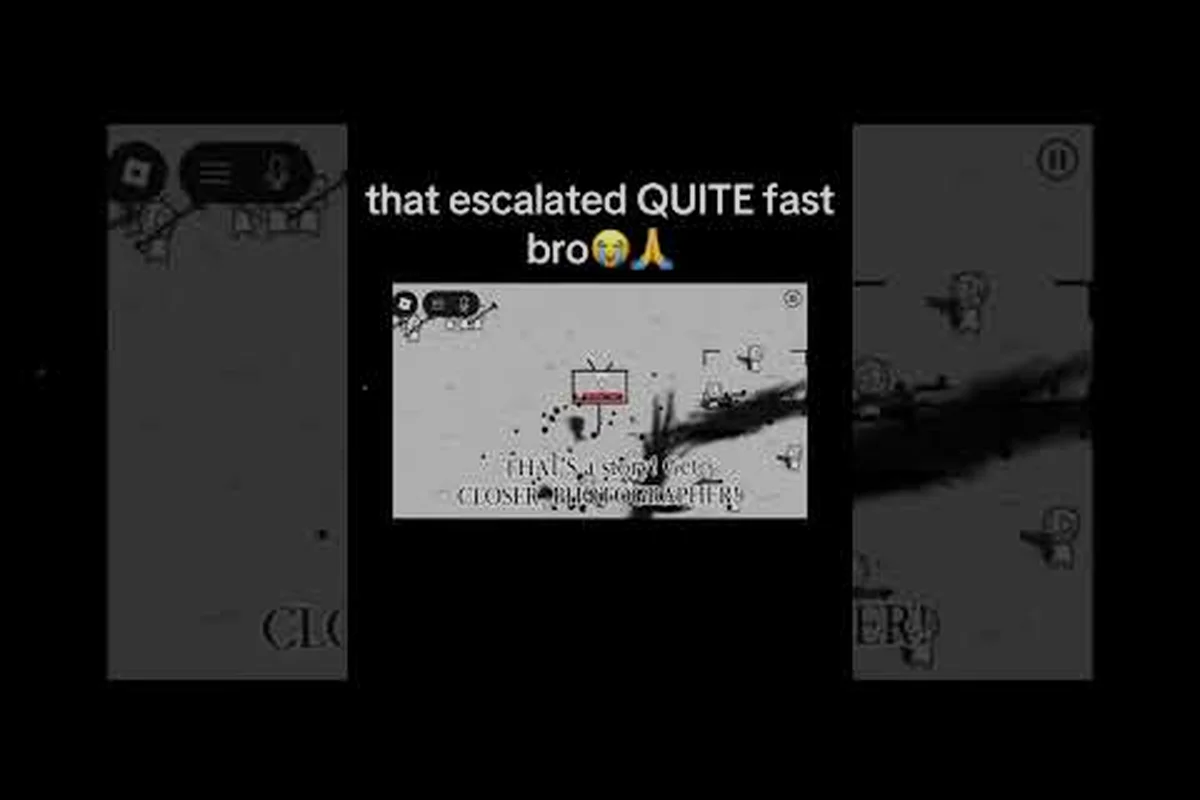
Say Cheese Roblox gameplay centers on a journalist spreading chaos in a park while an audience watches the news. The documented loop is short but meaningful: frame the situation, influence the crowd, and face the consequences of your reporting choices.
The Loop the Description Implies
The official Roblox listing gives players a clear premise rather than a long feature list. You play as a journalist hired by Big Media, arrive in a park, and are expected to create disorder while a mass audience follows the latest report. The page frames the story as a choice between damaging a peaceful society and changing events to bring hope.
That premise implies a repeatable exposure–reaction–choice structure. Your journalist assignment creates the initial exposure in the park, while the news broadcast theme explains why public disruption matters: the audience turns your actions into the latest report. Watching reactions reveals how the crowd responds to the camera and its consequences, then lets you choose whether to continue the chaos, redirect events toward hope, or accept a different outcome. The table below separates documented stages from gameplay details that still require in-game verification.
| Loop stage | Documented? | What to observe |
|---|---|---|
| Assignment | Yes | Your role is tied to media work and the instructions from Big Media |
| Location | Yes | The central setting is a park |
| Public disruption | Yes | The stated objective is to spread chaos and panic |
| Audience response | Yes, in theme | Billions are said to watch the latest news |
| Consequence choice | Yes | The page contrasts destroying society with bringing hope |
| Camera use | Implied by title and opening line | The official page says you are on camera, but the exact operation is not documented |
The public-facing frame is the part players can rely on. The title includes a camera symbol, and the page begins with the idea that you are on camera. However, that does not establish the precise function of the camera, its controls, or the order in which a photo-related action occurs.
A useful way to read Say Cheese Roblox mechanics is through three layers. First comes the journalist premise, which is explicit. Second is the news broadcast theme, which is explicit in the description. Third is any specific camera action, which must be confirmed in game unless the creator publishes a clearer explanation.
| Layer | Supported information | Safe conclusion |
|---|---|---|
| Narrative role | Big Media hires a journalist | The player acts as a media worker |
| Objective | Spread chaos and panic in a park | Disorder is the stated approach to the assignment |
| Presentation | An audience watches the latest news | The action is framed as media reaching a mass audience |
| Binary theme | Destruction or hope | Player agency appears tied to meaningful moral direction |
| Camera operation | Camera theme appears in title and opening line | Exact usage is not documented; check in game |
Community videos (as of 2026-10-31) discuss multiple endings; the creator has not published a list, a count or any ending names, so treat them as unconfirmed. The official page also credits We Become What We Behold as an inspiration, but that confirms the shared theme of media and collective emotion—not the original game’s structure.
For a broader first-session reference, the Say Cheese! beginner guide can help organize your goals while keeping the official premise separate from community interpretation. Use the documented journalist assignment, public disruption, and audience response as anchors, then test the less certain camera mechanic in game. This avoids treating unconfirmed camera controls, photo timing, or ending names as fixed rules when the official listing supports only the broader media-and-chaos framework.
Role, Camera, Broadcast, Crowd
The strongest documented connection is between the player’s role and the crowd’s attention. Your actions are not presented as private; they become news for a huge audience. That makes audience reach the conceptual bridge between what you do in the park and how the broader society responds.
The broadcast element is equally important. A news report normally involves an event, someone recording or presenting it, and an audience receiving the coverage. Say Cheese Roblox broadcast gameplay appears to borrow that relationship, but the official listing does not specify whether a broadcast is a timed event, a scripted sequence, a live server event, or simply the framing of ordinary gameplay.
| Element | Official support | What can be reasonably said | What remains undocumented |
|---|---|---|---|
| Journalist role | Explicit | The player receives media-related instructions | The full task list and order |
| Park setting | Explicit | Much of the interaction occurs in a public park | The exact routes and boundaries |
| Camera theme | Strongly implied | The camera is part of the presentation or player identity | Button, timing, viewfinder, and reward behavior |
| News audience | Explicit | Public attention amplifies the action | Whether attention is measured numerically |
| Crowd response | Implied | The audience reacts to disorder and panic | Exact triggers, scripts, and branching |
| Consequence | Explicit | The story contrasts destruction with hope | How and when each direction is selected |
That table prevents a common mistake: treating every visually suggestive element as a confirmed mechanic. A camera shown on screen might represent a recording viewpoint, a presentation device, or simply the title concept. Say Cheese Roblox camera mechanic details require direct observation because the official page does not define them.
A practical camera test
Begin by recording what happens without assuming what the camera does. Note whether the view changes when interacting with people, whether the screen presents a framing device, whether the crowd reacts to the act of recording, and whether recording changes later consequences. Do not infer a named action from a single animation.
The camera-action observation checklist should distinguish the Say Cheese Roblox camera mechanic from a simple screenshot by comparing the player’s normal first-person view with the activated recording state. For example, test one NPC interaction, note whether the Say Cheese camera shifts angle or displays a framing overlay, then repeat the interaction without pressing the apparent photo control. This comparison helps identify whether the camera mechanic merely documents the moment or triggers a separate Say Cheese Roblox gameplay event; treat a single visual reaction as evidence, not proof of a named action.
-
Visual evidence: framing overlays, viewpoint changes, or animation changes.
-
Input evidence: a control that appears to activate recording.
-
World evidence: another character or crowd reaction following that input.
-
Consequence evidence: a later change tied to the recorded moment.
Reading crowd reactions carefully
Crowd behavior is likely the most visible route into Say Cheese Roblox how it works, but it can also encourage overconfident conclusions. Write down the trigger: your presence, proximity, a specific interaction, a camera action, or an event already in progress. Then record the immediate response before moving elsewhere.
For example, a group reacting after you approach a sensitive area does not prove that panic has a numerical meter. A broadcast-style visual appearing after a camera input suggests a connection, yet it does not establish whether the recording can be shared, reviewed, or used later. This method preserves useful observations without turning them into rules.
The deeper question is how media influence works. Does the game treat attention as a resource, a visual condition, or a narrative state? The official page supports the idea of influence but not its internal representation. To investigate that distinction in one sitting, keep a timeline of cause and effect rather than only recording final outcomes.
What the Game Asks You to Do Minute by Minute
The official description provides enough structure for a minute-by-minute observation plan, even though it does not provide a complete walkthrough. Enter, observe the assignment, identify the park’s active situation, create a visible disruption, watch the reaction, and make a consequential choice.
| Time | Player action | Evidence to record | Decision rule |
|---|---|---|---|
| 0:00-0:30 | Read the opening and locate yourself | Role, instructions, camera-related prompts | Treat explicit instructions as stronger than inference |
| 0:30-1:30 | Walk around the park | Public areas, people, active events, camera controls | Build a map without labeling unknown objects |
| 1:30-2:30 | Interact with one situation | Dialogue, movement, crowd response | Isolate one action before testing another |
| 2:30-3:30 | Test the camera or broadcast theme | Visual feedback and immediate reactions | Separate recording from presentation |
| 3:30-4:30 | Change your approach | Different reactions or narrative cues | Look for cause-and-effect differences |
| 4:30-5:30 | Revisit an earlier area | Persistent state or changed behavior | Determine whether consequences travel |
| 5:30-6:30 | Choose a direction | Selection prompt, branching scene, ending-like presentation | Describe only what appears in your run |
| 6:30-7:30 | Compare notes | Exact sequence and unresolved questions | Mark each claim official, observed, or unverified |
This schedule uses the documented loop without inventing missing steps. The most important action is isolation: interact with only one person or event, wait for the response, then repeat the test elsewhere. If you combine several actions, a crowd reaction may appear to confirm the wrong cause.
Track variables, not labels
Begin with a neutral log: location, action, immediate visual change, crowd change, camera-related change, and later consequence. This avoids giving an unidentified feature a fixed name too early. It also helps you distinguish a narrative response from a temporary animation.
The observation chain should contain five links: connect each visible change to its cause, record the camera’s exact state at that moment, and separate a persistent gameplay effect from a temporary animation. For example, if the view shifts after a photo, note whether the character, background, and crowd framing change together; that comparison can reveal whether the Say Cheese camera mechanic affected the scene rather than merely producing a brief visual cue. This also helps distinguish a meaningful response to the broadcast from an ordinary Roblox animation triggered while taking photos. 2. Immediate feedback: sound, animation, text, or camera movement. 3. Audience response: whether nearby people alter their behavior. 4. Persistence: whether the change lasts after you leave. 5. Consequence: whether later scenes or people react differently.
- Trigger: the exact input or contact point.
One variable per test
Test the camera view first without changing location, establishing whether the Say Cheese! camera mechanic simply frames the scene or alters nearby player behavior. Then repeat the test near a crowd to measure changes in crowding, movement, and visible reactions. Finally, combine the camera action with an interaction such as a broadcast or photo attempt, comparing the result against the two isolated runs. These three controlled tests distinguish a basic camera action from one that modifies the social environment and reveal whether the effect persists after the camera is used.
The official promise of chaos and panic suggests that disorder should be observable. It does not tell you how much is required, whether escalation is gradual, or whether certain approaches are irreversible. Those details are not documented, so check in game rather than copying an unsupported routine from another experience.
For deeper analysis of the public-facing premise, the journalist and camera-game overview provides useful context, while this article remains focused on mapping the actual loop. In Say Cheese! gameplay, treat the public description as a hypothesis rather than a confirmed rule: compare the camera mechanic, broadcast interaction, and taking photos tool separately, then record whether nearby players redirect movement, crowd the photographer, or react after the shutter. That distinction matters because a visual framing effect can resemble a behavioral trigger without actually changing the Say Cheese Roblox mechanics.
Mapping Undocumented Systems Yourself
A one-session field test can produce more reliable information than repeated hearsay. Before playing, prepare a sheet with rows for candidate systems and columns for evidence. During the session, mark each feature as confirmed by observation, disputed by community reports (as of 2026-10-31), or not documented.
| System | Present? | Evidence |
|---|---|---|
| Camera input | Unclear | Record the button, animation, and visual result in game |
| Saved photographs | Unclear | Look for persistence or review behavior |
| Live broadcast | Unclear | Determine whether news presentation changes continuously |
| Crowd attention state | Implied, exact form unclear | Record what changes after escalating disruption |
| Choice consequences | Implied by official framing | Note the prompt and the resulting scene |
| Multiple outcomes | Community reports only as of 2026-10-31 | Compare your own runs without assuming a list |
| Any specialized system | Not documented | The official page does not identify one; check in game |
This checklist is intentionally functional. It avoids the error of asking whether an unnamed feature exists when the official page has not documented that category at all. Instead, it asks what evidence would make a feature visible during ordinary play.
Build a clean test matrix
Run each test twice. First, complete it in a fresh session without commentary or additional interaction. Second, repeat it with only one changed variable. This method is especially useful for determining whether a crowd reacts to proximity, an interaction, or the camera mechanic.
| Test | Variable changed | Compare | Useful conclusion |
|---|---|---|---|
| A | No action near the same area | Behavior before and after approach | Establish a baseline |
| B | Camera input only | View and crowd reaction | Isolate camera feedback |
| C | Crowd interaction only | Behavior without camera input | Separate social response |
| D | Both inputs | Combined result | Look for an interaction |
| E | Different location | Same action elsewhere | Check location-specific behavior |
| F | Different order | Same final actions | Detect sequence sensitivity |
A controlled baseline is essential. Stand in an area for the same number of seconds, note any ambient movement, and then perform the candidate action. Without a baseline, an environmental animation can be mistaken for a response to your input.
Record evidence precisely
Use video clips for short tests and written notes for longer sequences. Timestamps make comparison easier. Write “crowd turned toward player after camera input,” not “camera controls crowd.” The first statement records an observation; the second claims a mechanic that has not been established.
Also separate immediate feedback from delayed consequence. A visible reaction can happen while the camera is active, but the official page does not tell us whether that reaction causes a later branch. The news-broadcast decision overview can help frame the ethical side of the reporter’s choices, but your own notes should establish the sequence.
Ask sharper questions
Instead of asking “What are all the features?”, test the Say Cheese camera mechanic through a controlled sequence: choose one objective, record the prompt shown by the game, and then trigger one input at a time. This isolates whether an on-screen change came from framing, timing, crowd position, or the broadcast action itself, giving each playthrough a clear cause-and-effect log.
-
Which instruction did the game give directly?
-
What changed immediately after the input?
-
Which portion of the crowd reacted?
-
Did the change persist?
-
Did a later scene acknowledge the earlier event?
-
Could the same result have resulted from another action?
These questions turn vague impressions into a replayable map and help identify the real Say Cheese Roblox mechanics rather than a collection of assumptions. For example, if the Say Cheese camera mechanic appears to produce a score increase, compare the same prompt with the camera aimed at an empty background, then repeat it with a larger crowd visible. A Say Cheese Roblox taking photos test like this can separate a genuine scoring rule from crowd placement, timing, or a broadcast overlay; if the score changes only when the prompt is fulfilled, that supports a direct link to the photo action instead of incidental movement in the Say Cheese Roblox gameplay.
Separating Design From Absence
Not every unclear screen is a bug, and not every missing explanation proves that a feature does not exist. The creator’s public information is intentionally sparse: the official page states the premise and thematic choice, while no official website, Discord, YouTube channel, social account, or published changelog was available as of 2026-10-31.
| Symptom | Likely cause | Next step |
|---|---|---|
| No visible explanation for a control | The official page does not document it | Test the control in a safe, repeatable situation |
| Different crowd response on a second run | Randomness, sequence order, or another action | Compare clean runs and change one variable |
| Camera behavior changes by location | Context-dependent presentation may be involved | Repeat the input across several areas |
| A prompt appears without explanation | Context may depend on earlier choices | Record the full sequence before and after it |
| Nothing responds to an expected input | The intended trigger may differ | Try proximity, interaction order, and camera use separately |
| Results differ from community descriptions | Community information may be incomplete | Verify in game and label your result as observed |
This distinction is essential for Say Cheese Roblox gameplay analysis. Design silence means the creator has not published an explanation of the camera mechanic, taking photos mechanic, broadcast, or control; behavioral absence means a specific action produced no visible result during your test. For example, if aligning the camera with a character yields no photo prompt, first repeat the interaction in the same location, then try a different camera angle or interaction order. A lack of response identifies an unconfirmed observation, not a malfunction, especially because the available data does not establish whether a feature is missing, undocumented, or triggered by conditions you did not reproduce.
Why the official page matters
The official Say Cheese! experience page remains the primary authority for the game’s premise. It identifies the journalist role, park setting, mass-news audience, and choice between chaos and hope. It also lists the experience as Adventure / Story with a Minimal maturity label.
The same listing shows a large early audience: 3,955,237 visits, 13,403 playing, and 49,747 favorites as of 2026-10-31. It also records 12,154 likes against 1,369 dislikes, about 90% positive, as of 2026-10-31. Mechanical Boy LLC’s group had 4,810 members as of 2026-10-31.
Those figures establish interest, not a detailed design breakdown. The game’s release date was October 19, 2026, and its last listed update was October 31, 2026. Because the experience is new and the documentation is sparse, dated observations are more valuable than timeless claims.
Interpret the camera carefully
Say Cheese Roblox taking photos may sound straightforward, but the official material does not confirm that photographs are saved, scored, exchanged, or required. It also does not establish whether the camera is a tool, a viewpoint, or part of the news presentation. A responsible player will describe exactly what appears and avoid assigning a larger function until the game demonstrates it.
Likewise, Say Cheese Roblox camera gameplay should not be confused with an automatic recorder. Confirm whether you must press a control, whether framing is automatic, and whether the crowd sees the action. If those details cannot be observed, mark them not documented and check in game during another session.
A final verification pass
Before closing your notes, replay the decisive interaction from memory, then verify it against the recording. Write one sentence for the trigger, one for the response, and one for the later effect. Highlight which part came from the official page, which part came from direct observation, and which remains community interpretation.
This triage produces a defensible account of Say Cheese Roblox how it works: a documented journalist assignment, a public setting, a crowd exposed through news, a camera theme, and meaningful choices shaped by consequence. It also keeps the experience grounded rather than turning suggestive visuals into unsupported systems.
Community videos (as of 2026-10-31) discuss multiple endings; the creator has not published a list, a count or any ending names, so treat them as unconfirmed. That sentence is not a spoiler or a route; it is a boundary around what can honestly be claimed.
The practical takeaway is simple: treat the game as an observation-driven media story. Watch what your journalism changes, isolate the camera mechanic from the crowd reaction, and compare the same action across locations. That method reveals more than guessing from a title or repeating a community shortcut.
Frequently Asked Questions
What is the core Say Cheese Roblox gameplay loop?
The official premise places you in a park as a journalist hired by Big Media. You create chaos, observe how the public and news audience react, and then face a choice between destruction and hope. The precise sequence beyond that framework is not documented, so check in game for the current implementation.
Does the camera take pictures in Say Cheese Roblox?
The title and opening line strongly suggest a camera theme, while the official description discusses being on camera. It does not explain the camera control, whether photographs are saved, or how they affect consequences. Treat Say Cheese Roblox camera mechanics as observed in game rather than assuming a standard photography action.
How does Say Cheese Roblox broadcast gameplay work?
The story explicitly frames the action as news watched by a vast audience, which makes broadcast attention a central theme. The official page does not state whether a broadcast is live, timed, or represented by a separate interface. Check in game and record whether crowd reactions change during or after a news-related sequence.
Are community claims about different outcomes reliable?
Community videos (as of 2026-10-31) discuss multiple endings; the creator has not published a list, a count or any ending names, so treat them as unconfirmed. Compare your own runs, record the choices that differ, and use only what you directly observe as confirmed. The official page supports the broader conflict between chaos and hope.
What should I record during my first session?
Capture the role assignment, camera-related controls, immediate crowd reactions, persistent changes, and the final decision sequence. Test one variable at a time and include a baseline period before each action. This creates a reliable account of Say Cheese Roblox mechanics without confusing environmental animations with consequences.