
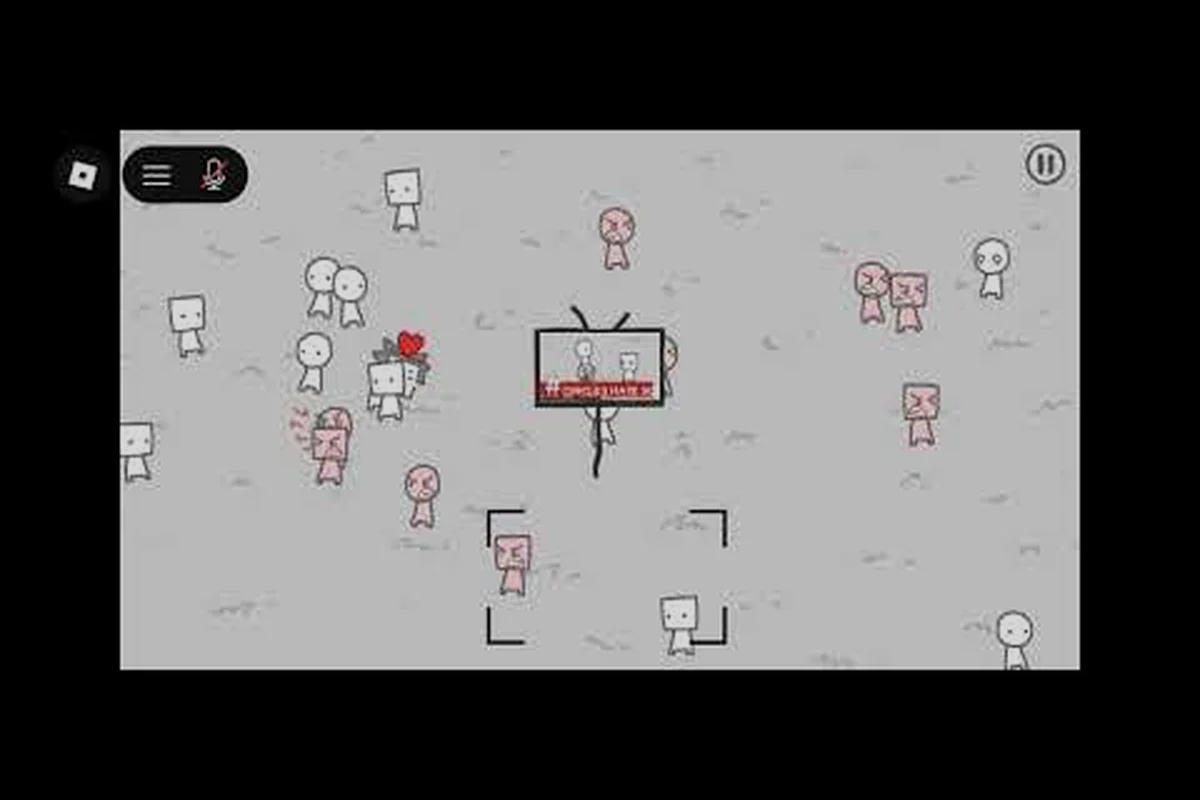
Say Cheese! Roblox media criticism matters because the game turns a journalist’s assignment into a playable argument about attention, panic, and public responsibility. The official premise places a media worker in a park, orders them to create chaos for a massive audience, and closes with a choice between destruction and hope.
The Target of the Say Cheese! Roblox Media Criticism
The game’s most obvious target is the news system rather than journalism as a profession. Its official description casts the player as someone hired by “Big Media,” sent into a peaceful public space to spread disorder while billions watch the latest report. That setup turns a conventional reporting fantasy inside out: instead of seeking facts, the player becomes an agent whose value is tied to disruption.
That distinction matters because Say Cheese! Roblox news satire does not simply depict bad journalism as a collection of villains. It builds the argument around a conflict of incentives. A media outlet is represented as an organization that benefits from spectacle, while the journalist is placed inside that system with a mission that rewards making people afraid. The player can criticize the institution while still following its instructions.
The official page does not document every character, location, or piece of dialogue, so a precise critique map should remain limited to verified framing. For factual confirmation and identity checks, the owner profile linked from the group page is the clearest public reference for the project’s creator identity.
Reading the central conflict
Three premises establish the satire: a journalist receives the assignment, the assignment requires chaos and panic, and an enormous audience is expected to watch. In Say Cheese, the camera makes that bargain explicit: Big Media wants attention rather than calm, so “chaos” becomes the journalist’s measurable objective and “billions” of viewers become the anticipated market. The peaceful park supplies a controlled contrast; when the player deliberately creates panic, the setting exposes how a news spectacle can turn ordinary public space into a site of manufactured disorder.
| Target | Evidence in text | Strength |
|---|---|---|
| News spectacle | The assignment is measured by chaos and panic | Direct |
| Institutional incentives | The journalist works for “Big Media” | Strong |
| Audience complicity | Billions are expected to watch | Direct but broad |
| Public vulnerability | The assignment takes place in a peaceful society | Central |
| Individual responsibility | The player can reject the destructive path | Open to interpretation |
The result is a critique of an attention economy: a system in which fear can become useful content because attention follows disruption. The title reinforces this idea through the language of being watched, while the opening line places the player under public scrutiny. Together, those details suggest that the journalist is both an active participant and a subject of the system.
That double position prevents the game from treating the audience as a neutral background. The audience does not merely witness the park; its expected attention helps give the journalist’s behavior meaning. The critique is therefore not simply “reporting is bad.” It asks what happens when consequences are converted into content and moral responsibility is distributed among cameras, executives, journalists, and viewers.
The official framing also leaves enough ambiguity for different interpretations. One reading sees a warning about institutions that reward cruelty because it attracts an audience. Another sees a challenge about the difference between exposing wrongdoing and manufacturing it. A third wonders whether the camera makes someone responsible for being watched, even when the order itself comes from elsewhere.
How Satire Transfers an Argument Through Play
Satire becomes stronger when a player experiences the argument rather than merely hearing a lecture. Say Cheese! Roblox media criticism is carried through the assignment structure: the player receives a goal, acts inside a supposedly peaceful setting, and then encounters the ethical weight of the choice described on the official page.
This is an important distinction. A topical story may mention media manipulation while leaving the audience outside the process. A playable satire can ask the audience to consider what it feels like to cause panic while knowing that cameras may reward the result. The player then confronts the possibility that the assignment itself has been designed to reward harm.
Devices, effects, and risks
| Device | How it works | Risk |
|---|---|---|
| Role reversal | The journalist creates disorder instead of merely reporting it | Can feel like a simplified portrait of journalism |
| Dramatic framing | A public assignment places the player under observation | May make media appear exclusively hostile |
| Escalating binary | The choice contrasts destruction with hope | Can compress complicated ethics into two poles |
| Peaceful setting | The park makes the cost of panic visible | The setting’s details are not documented |
| Audience scale | Billions watching magnify the stakes | The phrase is broad and may lack specificity |
The mechanism transfers the argument through role displacement. Players often learn a system by acting within it, so placing the player on the side that benefits from panic can expose how an institution might reward behavior that sounds indefensible in ordinary conversation. The player does not need to accept the conclusion, but the experience makes the premise harder to ignore.
The tone also matters. A dark story can create horror, but darkness alone is not satire. The critical ingredient here is the mismatch between peaceful public life and the profitable production of fear. If the game simply dramatizes terrible events, that would be tragedy or shock. If those events are generated as a media assignment, the professionalization of panic becomes the satirical target.
That distinction is why a Say Cheese! Roblox plot summary should focus on the relationship between the journalist, the assignment, and the audience. A summary limited to “the player causes chaos in a park” misses the point. The park is the condition; the assignment supplies the institutional logic; the watching audience supplies the incentive.
Readers who want a broader account of the game’s premise can use the Say Cheese! story overview as a companion to this criticism-focused reading. The useful division is simple: one article establishes the narrative frame, while this one evaluates how that frame argues through play.
Chaos, Panic and Attention as Satirical Material
Chaos and panic are not merely events within the setting. They are the products the player is ordered to create, which means the game can examine how suffering becomes valuable once it is packaged as news. That is the sharpest component of Say Cheese! Roblox news satire: the desired outcome and the socially harmful outcome occupy the same position.
Attention serves a similar role. The official description implies that a huge public will see the latest news, so the player’s behavior is judged within a mass-media relationship. The game therefore asks whether visibility automatically creates accountability. If every incident becomes spectacle, a harmful act may be excused as entertainment while also attracting more attention.
A media-incentive reading
| Moment or concept | Critical question | Likely interpretation |
|---|---|---|
| Assignment from Big Media | Who benefits from the assignment? | Institutional responsibility is distributed |
| Journalist on camera | Is observation merely exposure? | Visibility can become pressure |
| Panic as newsworthy | Why does the audience keep watching? | Attention rewards disruption |
| Peaceful society | Who bears the immediate cost? | Public welfare is treated as expendable |
| Hope as an alternative | Can attention serve a constructive purpose? | Media influence is not necessarily inherently harmful |
A reader should avoid treating the term “satire” as proof that the game endorses one exact political conclusion. Satire often works by exaggerating a real tendency until it becomes uncomfortable. Here, the exaggerated tendency is that an organization focused on audience interest may reward a journalist for manufacturing the very crisis that attracts viewers.
The official framing nevertheless leaves one major question unresolved: how the player understands the park’s residents and whether they are given agency. That detail is not documented in the public materials. Check in game for the clearest expression of their reactions, but do not assume that every resident exists only as scenery or that every response supports a fixed political reading.
The camera motif is equally ambiguous. “You’re on camera!” tells the player that visibility matters, but it does not specify whether the camera grants status, creates danger, amplifies misconduct, or serves several purposes at once. A careful analysis can use the motif as evidence of scrutiny without claiming a precise undocumented function.
Reading actions without inventing mechanics
The safest approach to interpretation is to separate three layers: the officially documented premise, critical inferences drawn from that premise, and unverified claims circulating in community videos. This matters because the park-assignment setup, destructive-versus-hopeful choice, and watching audience can support a media-criticism reading of Say Cheese! without turning speculation about endings, dialogue, or resident behavior into established plot facts. The distinction preserves critical space while avoiding a spoiler-heavy recap disguised as analysis.
-
Official premise: the journalist, park assignment, chaos, panic, watching audience, and destructive-versus-hopeful choice.
-
Critical inference: spectacle may reward disorder and distance the institution from responsibility.
-
Unverified detail: exact dialogue, resident behavior, scene order, and interpretation cues not documented on the official page.
This method prevents the analysis from becoming a spoiler-heavy transcript in disguise. Community videos (as of 2026-10-31) discuss multiple endings; the creator has not published a list, a count or any ending names, so treat them as unconfirmed. A reader can still discuss the moral choice without treating third-party descriptions as official facts.
For a concise look at the playable framing, the news-game guide can help separate the experience’s structure from a purely literary reading. That distinction matters because a satire can critique a system while still using familiar game conventions to direct the player’s attention.
The Hope Ending as a Satirical Counterweight
The official description presents a binary: destroy the peaceful society or change fate to bring hope. Calling one path the “Hope Ending” is supported by the language used in that public framing, but the broader story summary should still avoid inventing the route taken to reach it. The important analytical point is not how the outcome is obtained; it is what the alternative does to the argument.
Hope complicates a satire built around spectacle. If chaos attracts viewers, hope could appear naive or unmarketable unless the game suggests another model of attention. That possibility makes the hopeful branch a counterweight rather than a simple reward for moral behavior. It asks whether media influence can help people imagine a better outcome instead of amplifying the most alarming moment.
| Question | Destructive framing | Hopeful framing |
|---|---|---|
| What is valuable about news? | Conflict and panic | Meaningful change or collective hope |
| What does the journalist serve? | Audience appetite | A chosen social direction |
| Who controls the frame? | Institutional demand | Individual decision within limits |
| What is satire testing? | The normalization of harm | Whether influence can resist spectacle |
| What should the audience question? | Why watch harm? | Why prefer despair to possibility? |
A hopeful outcome can be read as a deliberate refusal of tragic determinism. If the player’s entire environment pushes toward chaos, choosing hope makes agency visible. Yet the framing also risks offering a simple moral escape after demonstrating that systems reward cruelty. The critique is strongest only if viewers continue asking whether personal intention is enough inside a media structure that rewards particular behavior.
The wording “change fate” is significant because it implies alteration rather than simple prevention. It may suggest that the player influences an outcome or redirects collective expectation. Exactly how that process appears is not documented, so the analysis should remain conceptual: the game visibly places hope against destruction as a choice worth making.
This branch also prevents the critique from being misread as “anything can be justified.” The alternative is not merely less chaos; it is a different destination for attention and narrative power. A media system can still be examined critically while the game asks whether its influence might produce solidarity rather than fear.
The balance also depends on tone. If hope feels fully rewarded, with no tension or ambiguity, the game may close too neatly. If it feels remote or narratively unearned, the hopeful alternative may carry less persuasive force. Since the official page does not document the full sequence, the best analysis watches how the game stages uncertainty rather than assuming a simplistic moral verdict.
Evaluating a Critique You Disagree With
A strong review should not require agreement with the game’s political conclusion. Say Cheese! Roblox media criticism is most useful when evaluated by asking what the game demonstrates, how clearly it demonstrates it, and what costs come with its simplification.
The first task is separating evidence from implication. The journalist’s assignment and the watching audience are official. The idea that Big Media is deliberately cultivating panic is a credible interpretation of that arrangement, but the page does not establish the organization’s entire philosophy. Good criticism labels the difference.
The second task is checking whether form and message reinforce each other. If the game asks players to think critically about spectacle while making spectacle the easiest way to gain attention, that contradiction may be meaningful. If the form merely repeats the message without pressure or ambiguity, the satire may feel didactic. This is a design judgment based on play, and the official description alone cannot settle it.
Evaluation criteria for media criticism
| Criterion | Question | Note |
|---|---|---|
| Argument clarity | Can a reader state the institutional critique? | Should emerge from the premise |
| Player agency | Does the choice meaningfully complicate obedience? | Evaluate in play |
| Nuance | Does the game avoid treating all viewers as equally responsible? | Check presentation and dialogue |
| Consequence | Does the audience feel the cost of spectacle? | Interpret from the in-game response |
| Internal consistency | Do form and theme reinforce each other? | Do not reward hypocrisy automatically |
| Emotional balance | Does hope carry comparable weight to fear? | Avoid assuming a simplistic triumph |
| Interpretive openness | Can the critique sustain more than one reading? | Separate messages from possible subtext |
A reader may reject the framing for a valid reason. Perhaps it understates the pressure journalists face, or treats viewers as passive consumers when media systems also shape what can be seen. A critical response does not need to deny that the game offers a critique; it can test the critique’s limits.
It also helps to avoid using the dark story label as a substitute for analysis. Darkness describes atmosphere, while criticism describes an argument about institutions and incentives. The Say Cheese! Roblox dark story becomes analytically interesting when fear is connected to a professional demand for panic, rather than presented as an effect for its own sake.
The game’s reception history gives context but should not substitute for interpretation. As of 2026-10-31, the official Roblox page listed 3,955,237 visits, 13,403 players, 49,747 favorites, and 12,154 likes against 1,369 dislikes, or about 90% positive. The creator group had 4,810 members. These figures show substantial early interest, but they do not prove that viewers accepted the political argument.
A spoiler-aware review method
For a Say Cheese! Roblox spoiler story, disclose only what the reader needs to evaluate the game’s media satire, and distinguish verified game content from uncertain community readings. Before interpreting the journalist-and-Big Media premise, note the player’s news assignment, the pressure to conform, and whether any “hope” objective genuinely changes the coverage; then assess how the ending complicates that role structure without rewriting earlier choices as foreshadowed intent.
-
Record the official premise before playing.
-
Note where the game asks for obedience and where it invites reflection. 3. Compare the stated choice with the consequences shown in play. 4. Separate documented framing from community interpretation. 5. Return to the journalist and Big Media context to test whether your reading fits the role structure.
This method prevents hindsight from rewriting the opening setup. If the final experience seems obvious only after reaching its conclusion, a reviewer should ask whether the setup planted fair signals, whether the game withheld information unfairly, and whether its ambiguity is productive.
The most persuasive evaluation is also specific. “It has a message” is too broad; instead, ask whether the player’s news assignment makes the incentive toward panic understandable, whether hope gives attention a different purpose, and whether the ending complicates or merely closes the argument.
Frequently Asked Questions
What is Say Cheese! Roblox media criticism about?
Say Cheese! Roblox media criticism centers on a journalist assigned to create chaos while a vast audience watches. The game uses that premise to question how media institutions can reward attention, fear, and spectacle. Its argument is carried through the player’s role and the destructive-versus-hopeful choice rather than through a detached essay.
Does Say Cheese! Roblox news satire criticize all journalists?
No. The official premise places the player in a particular arrangement involving Big Media, public panic, and a newsworthy assignment. That supports criticism of incentives and spectacle, but it does not justify treating every journalist as identical. A careful reading considers the institution, the individual assignment, and the audience as separate parts of the system.
Is Say Cheese! Roblox a dark story?
Its dark imagery or situations should not be confused with its critical argument. The official framing places a journalistic mission against a peaceful society, so the darkness makes the cost of manufactured crisis visible. The satire depends on that relationship: fear is not simply atmosphere but a product that gains value through attention.
What does the Say Cheese! Roblox plot summary establish?
The official summary establishes that the player is a journalist hired by Big Media, sent to a park to spread chaos and panic for an enormous audience. It also frames the final decision as either destroying a peaceful society or changing fate to bring hope. Further scene details are not documented on the public page and should be checked in game.
Can a spoiler story reveal how the media critique ends?
Yes, but it should distinguish official evidence from interpretation. Community videos (as of 2026-10-31) discuss multiple endings; the creator has not published a list, a count or any ending names, so treat them as unconfirmed. A reliable spoiler analysis focuses on the documented final choice, explains how its presentation supports the satire, and clearly labels community reports rather than presenting them as creator facts.
In short, Say Cheese! Roblox media criticism is strongest when treated as an argument about incentives: panic becomes valuable because attention follows it, the journalist operates inside those incentives, and hope asks whether the same influence can serve another purpose. Evaluate the game by checking whether its play, choices, and tone reinforce that challenge rather than assuming that the official premise settles every interpretation.