
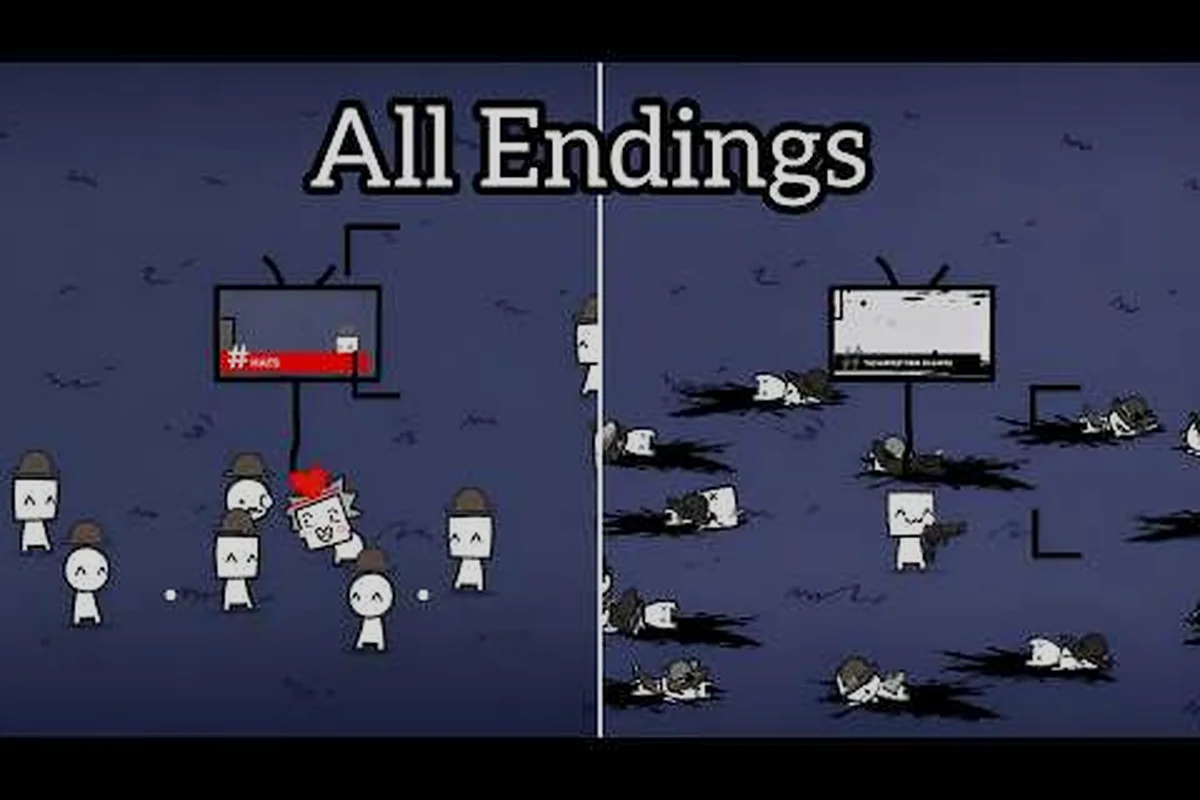
Say Cheese! Roblox compared to its cited inspiration is a useful theme-level comparison, not a claim that one game copies the other’s structure. The official page identifies We Become What We Behold as the source of the idea while presenting a journalist, a camera, and a media spectacle. This guide separates what the two share from what only the Roblox page actually confirms.
The Comparison the Creator Invites
The creator of Say Cheese! explicitly says the experience is based on We Become What We Behold, the browser game by Nicky Case. That statement creates a legitimate starting point for a comparison, because both works are connected to the way media turns individual behavior into a public spectacle. However, the official description gives players a journalist working for “Big Media,” places the action in a park, and frames the mission around spreading chaos and panic for a massive audience.
The official Say Cheese! listing page is the primary source for what can be said about the Roblox experience. Its public listing labels the game as Adventure / Story and includes a camera motif in the opening line. It does not provide a detailed design breakdown, so the comparison should remain anchored in the premise and themes rather than unsupported assumptions about play.
What the official description establishes
The creator’s wording gives readers a concise framework for comparing the games. Rather than listing mechanics that are not documented, it is more accurate to identify the core premise, setting, role, media framework, and central choice described on the page.
| Official element | What the page establishes | Comparison value |
|---|---|---|
| Player role | A journalist hired by Big Media | Connects the player to media production |
| Setting | A park | Establishes a public environment |
| Objective | Spread chaos and panic while billions watch | Places the action inside a news spectacle |
| Framing choice | Destroy society or bring hope | Signals a morally divided decision |
| Game type | Adventure / Story | Identifies the broad Roblox category |
This matters because a theme-level comparison can be detailed without pretending that undocumented Roblox systems resemble a separate game’s structure. The official material establishes a clear media premise, but it does not support claims about how the story is divided, what choices unlock, or how the experience progresses.
A fair first conclusion
When asking whether Say Cheese! Roblox is better than its inspiration, the answer depends on the comparison criterion. Theme clarity and accessibility are separate from structural depth, and the available official evidence for Say Cheese! is too limited to declare either work categorically superior. The Roblox game is easier to identify by platform and broad genre, while the comparison with the original should focus on satire rather than feature parity.
The cited inspiration works as a lens for reading media, public reaction, and collective emotion. It is not evidence that the Roblox adaptation reproduces the original’s narrative form, interactive choices, presentation, or replay structure. A responsible comparison asks whether Say Cheese! develops its own expression of those ideas, not whether it contains a checklist of features associated with another release.
Shared Ground: Media and Group Emotion
The strongest shared ground is the idea that media does more than report events. It shapes attention, amplifies emotion, and turns individual conduct into something that a large audience interprets. In Say Cheese!, the journalist role and repeated emphasis on being watched place the player inside that process rather than presenting the camera as a neutral recording device.
This gives the Say Cheese Roblox genre a clear identity: it is a story-driven adventure about media spectacle and public behavior. That is more precise than simply calling it a platform game or a short Roblox experience. The official category supports the broad label, while the premise explains why the experience can be discussed as satirical or media-focused.
Theme overlap without content assumptions
A theme comparison asks whether two works interrogate the same social idea. It does not require transferring a character, scene, interaction, or narrative decision from one work to the other. The table below limits itself to the shared concern and clearly marks the boundary of available evidence. The key phrase is shared theme, not shared content. Readers who want more context on the broad Roblox presentation can consult the adventure and story genre analysis, but genre labels should support the theme analysis rather than replace it.
| Theme | Shared | Not shared or not established |
|---|---|---|
| Media amplification | Both place media influence at the center of the premise | Say Cheese! uses a Roblox journalist scenario; the original’s exact content is not evidence about the adaptation |
| Public scrutiny | Being watched appears central to the Roblox premise | The original’s presentation of public scrutiny is not copied into this game by default |
| Group emotion | Chaos and hope frame the Roblox choice around collective effects | Say Cheese! does not reuse documented groups from the original |
| Player agency | Choices matter as a theme in both contexts | Say Cheese! does not document the same choice structure as the inspiration |
| Satirical framing | Media spectacle can expose how attention alters behavior | Similar subject matter does not make the two works technically equivalent |
Why emotion is part of the comparison
The Roblox premise asks the player to create chaos in public, with billions watching, or choose a path associated with hope. That is inherently an emotional experiment: the same broadcast audience could amplify harm, reshape the story, or become associated with a different future. Media therefore acts as the mechanism through which a private act becomes a social event.
This connection explains why the cited inspiration is relevant. It gives the game a recognizable satirical framework for examining attention and collective reaction. Still, the Roblox description alone does not show how emotional feedback works in real time, what the player can control, or whether choices have equal weight. Those details are not documented, so players should check in game.
A media-satire lens
A useful lens is to observe four questions while playing: whether Say Cheese! uses a controllable camera, which chaotic actions trigger the strongest reactions, how its society-of-panic premise frames consequences, and whether the watching audience appears as an on-screen presence. Because the official page documents the mission and social framing more clearly than specific mechanics, direct testing is needed to separate confirmed features from assumptions about the game type and category.
-
Who controls the camera? The official page establishes that the player is on camera, but it does not document a controllable camera system.
-
What behavior attracts attention? The mission calls for chaos and panic, yet the exact actions that produce the strongest response are not documented.
-
How does the story frame consequences? The description explicitly contrasts societal destruction with bringing hope, although the decision process is not documented.
-
What does the audience represent? Billions are said to watch the news, but the page does not explain how the audience is represented on-screen.
Applied to a Say Cheese! comparison, these questions function like a verification checklist: each claim should be tagged as confirmed, plausible, or unsupported before it is used to judge whether the Roblox experience is stronger, weaker, or simply different from the alternative. That distinction matters because the social premise—being watched, provoking panic, and presenting chaos to a mass audience—can be analyzed from the official page, while claims about camera control, reaction triggers, or audience mechanics still require direct testing.
Where the Comparison Must Stop
The comparison must stop before it claims that Say Cheese! reproduces the original’s structure. The official Roblox listing provides a premise and broad genre, not a feature-by-feature map of the cited work. It would therefore be misleading to import the inspiration’s narrative architecture, presentation choices, or decision structure into the Roblox game.
Claim hygiene for an honest review
| Tempting claim | Problem | Correct framing |
|---|---|---|
| The Roblox game has the same story structure | Structural equivalence is not documented | Compare how each work treats its stated theme |
| Every choice changes the same way | The Roblox choice system is not documented | Describe only the moral fork stated officially |
| The Roblox adaptation contains the same scenes | No basis appears on the official page | Treat shared themes as separate from shared content |
| The Roblox version is more replayable | Replay conditions are not documented | Consider platform, session expectations, and individual play |
| The Roblox version improves the original | “Improvement” requires a shared criterion | Compare execution within a specific dimension only |
This is claim hygiene: each statement must match the available source. The official Roblox page is enough to verify the premise, broad genre, creator, release information, and stated choice. It is not enough to verify systems that the page leaves unexplained.
What is known versus what remains uncertain
Known facts are relatively compact. Say Cheese! launched on October 19, 2026, was last updated on October 31, 2026, and was created by Mechanical Boy LLC. The official listing describes a journalist, a park, news as the medium, a huge audience, and a morally divided choice. The game is categorized as Adventure / Story.
Other details require a different evidence label. The exact decision sequence is not documented. The way public emotion changes play is not documented. The connection between the camera and specific interactions is not documented. If a community video demonstrates a behavior, treat it as community reports (as of 2026-10-31) rather than as an official feature list.
That distinction also prevents a common error in “is it worth it versus” discussions. A short experience may reward one or two sessions while another may invite broader experimentation, but the amount of content in Say Cheese! is not documented by the official page. Its replay value should be judged from actual play rather than inferred from its relationship to a longer-form inspiration.
The correct kind of criticism
Good criticism can say that the camera framing makes the player complicit in the media spectacle. It can argue that the choice between chaos and hope creates an uncomfortable moral position. It can also ask whether the Roblox presentation makes audience emotion more visible than the premise initially suggests.
Those are interpretive judgments tied to documented setup. Riskier criticism would assert that the game copies a specific sequence from the original, mirrors its branching approach, or repeats its cast and events. Without that documentation, such claims are not criticism but fabrication. The best evidence is still the official game page plus direct observation.
Why Homage Is Not Porting
An homage borrows, reframes, or responds to an idea. A port transfers a designed work into another technical and cultural context, often preserving much more of its specific implementation. Say Cheese! is openly inspired by We Become What We Behold, but the official description supports calling it an adaptation of a theme rather than a direct port.
That distinction also explains why “Say Cheese! Roblox better than” is an incomplete question. A Roblox release and a non-Roblox work with a different presentation, audience, and interaction model may serve different purposes. One may be more convenient for a particular player, while the other may communicate its themes through a different form. Neither fact establishes an overall winner.
Four levels of relationship
| Level | Meaning | What the current evidence supports |
|---|---|---|
| Name overlap | Two works share a title | Not the basis of this comparison |
| Inspiration | The creator identifies a source of ideas | Explicitly supported by the official description |
| Theme adaptation | A central idea is reworked for another experience | Supported for media amplification and group emotion |
| Port or remake | Specific content and design are transferred | Not documented; should not be claimed |
The distinction is particularly important on Roblox, where short-form story games can be built around an immediately legible premise and playable in a single session. That makes the platform attractive for satirical experimentation, although the official listing does not promise a particular session length. The broader news and satire game overview examines the premise from that media-focused angle.
Creator influence versus platform identity
The title and first line point toward a camera, while the job title points toward journalism. Those details give the Roblox game its own recognizable frame even while sharing a satirical concern with the inspiration. The platform category then helps players set expectations: this is a Roblox adventure/story experience, not a conventional standalone adaptation merely hosted inside the service.
It is also worth separating creative lineage from technical format. A creator can invite players to think about media amplification through a Roblox experience without reproducing the source’s full production method. The official page does not provide a detailed account of those creative decisions, so the most responsible conclusion is narrower: the source is credited, the broad themes align, and the specific implementation remains something players evaluate directly.
A practical test for reviewers
When comparing Say Cheese Roblox experiences, place every claim about the journalist premise, roblox-news framing, and interactive journalism into one of three groups. For example, whether an interview sequence creates meaningful choice, how closely its reporting mechanics mirror real news work, and whether the presentation justifies its genre label should each be tagged by evidence level. This matters because a distinctive narrative premise alone does not prove stronger journalism design, while a criticism of choice framing should not be presented as an official Roblox judgment without documentation.
-
Officially documented: directly supported by the official Roblox page.
-
Community reports (as of 2026-10-31): observed by third parties but not confirmed by the creator. 3. Check in game: unresolved and best verified through personal play. This framework prevents enthusiasm from becoming misinformation. It also makes criticism sharper because each claim has a clear provenance. A reviewer can praise the journalist premise, question the choice framing, and still avoid making unsupported claims about the cited inspiration.
Comparing Two Satires Fairly
A fair comparison of two satires begins with a shared criterion. Theme, presentation, accessibility, length, and interaction are all legitimate dimensions, but they answer different questions. Calling one experience better without specifying the dimension turns analysis into a popularity contest.
Choosing meaningful criteria
| Criterion | Question to ask | Evidence for Say Cheese! |
|---|---|---|
| Theme clarity | Does the premise communicate its central concern quickly? | Journalist, camera, news, public chaos, and hope establish a clear media frame |
| Accessibility | Is the experience easy to identify and reach on its platform? | It is available through Roblox with a public game page |
| Structural fidelity | Does it reproduce the inspiration’s specific design? | Not documented, so no claim is appropriate |
| Replay value | Does repeated play reveal meaningful variation? | Not documented; verify in game |
| Session fit | Does it suit a short or extended play session? | Not documented; individual expectations may differ |
| Critical impact | Does the presentation strengthen its satire? | Depends on direct play and interpretation |
This avoids a misleading winner-take-all verdict. Say Cheese! may be preferable for someone seeking a Roblox-hosted, camera-centered story premise, but that does not mean it is better than the inspiration in every category. Comparative value depends on the standard being used, not on how confidently an article uses the word “better.”
What the snapshot says about reception
As of 2026-10-31, the official listing recorded 3,955,237 visits, 13,403 players currently playing, 49,747 favorites, and a vote count of 12,154 likes against 1,369 dislikes. That is roughly 90% positive based on the displayed votes. Mechanical Boy LLC’s public group had 4,810 members as of 2026-10-31, while the listed server capacity was 12; that number should not be presented as a feature or a co-op requirement.
These figures show early attention, but they do not prove artistic superiority. Visit totals can reflect novelty, publicity, and recommendation systems. Vote ratios offer a rough reception signal rather than a complete quality score. Neither metric says whether the Roblox work handles its satire more effectively than the cited inspiration.
| Snapshot measure | Value as of 2026-10-31 | What it can support |
|---|---|---|
| Visits | 3,955,237 | Evidence of substantial early attention |
| Players playing | 13,403 | Evidence of concurrent activity at that snapshot |
| Favorites | 49,747 | Evidence of stated user interest |
| Likes and dislikes | 12,154 and 1,369 | A roughly 90% positive displayed vote ratio |
| Group members | 4,810 | The creator group’s public membership snapshot |
Practical recommendations by player priority
Players seeking a compact story premise can start with Say Cheese! because its official setup is easy to grasp. Players interested in media satire should watch for how the camera, journalism role, and public audience shape the experience. Players expecting a structural replica of the inspiration should adjust their expectations and judge the Roblox work on its own terms.
Players who care most about replay should consult the worth-playing analysis for a broader evaluation, while recognizing that official documentation remains the best source for persistent mechanics. If a feature is unclear in the listing, the right move is not to fill the gap with the original game’s design but to check in game.
The most balanced conclusion is therefore conditional. Say Cheese! is clearly a Roblox Adventure / Story experience centered on journalism, cameras, spectacle, and a choice between chaos and hope. Its relationship to We Become What We Behold is explicit at the level of inspiration. Beyond that shared thematic frame, the current evidence does not support a sweeping declaration that the games are structurally alike or that one is universally superior.
Frequently Asked Questions
What is Say Cheese! Roblox compared to?
The official page credits We Become What We Behold, the browser game by Nicky Case as the inspiration. A careful Say Cheese! Roblox compared to analysis focuses on shared satire about media amplification, public attention, and group emotion. It should not claim that the Roblox game copies the inspiration’s specific structure, content, or choices.
Is Say Cheese! Roblox better than its cited inspiration?
That depends on the criterion. Say Cheese! may offer a more accessible Roblox-hosted story setup, while the cited work may appeal to players seeking its particular form of satire. Available official evidence for Say Cheese! is too limited to declare it better overall, so compare theme, presentation, and individual play preferences separately.
What genre is Say Cheese! Roblox?
The official Roblox listing categorizes Say Cheese! as Adventure / Story. Its documented premise also supports the broader description of a media-centered satirical adventure about a journalist, a camera, public chaos, and hope. The official page does not document a more specific subgenre.
What game type is Say Cheese! Roblox?
Say Cheese! Roblox game type is best described as an Adventure / Story experience with a role-centered premise and a morally divided decision. It is designed around the idea of being watched as a journalist creating a public spectacle. Exact interaction details are not documented, so players should check in game.
Is Say Cheese! Roblox worth it versus We Become What We Behold?
If you value a concise Roblox premise, a camera-centered frame, and a media-satire theme, Say Cheese! may be worth playing on its own terms. It is not automatically better than its inspiration, because structural fidelity is not documented. Your choice should reflect which presentation you prefer rather than an unsupported claim of direct equivalence.